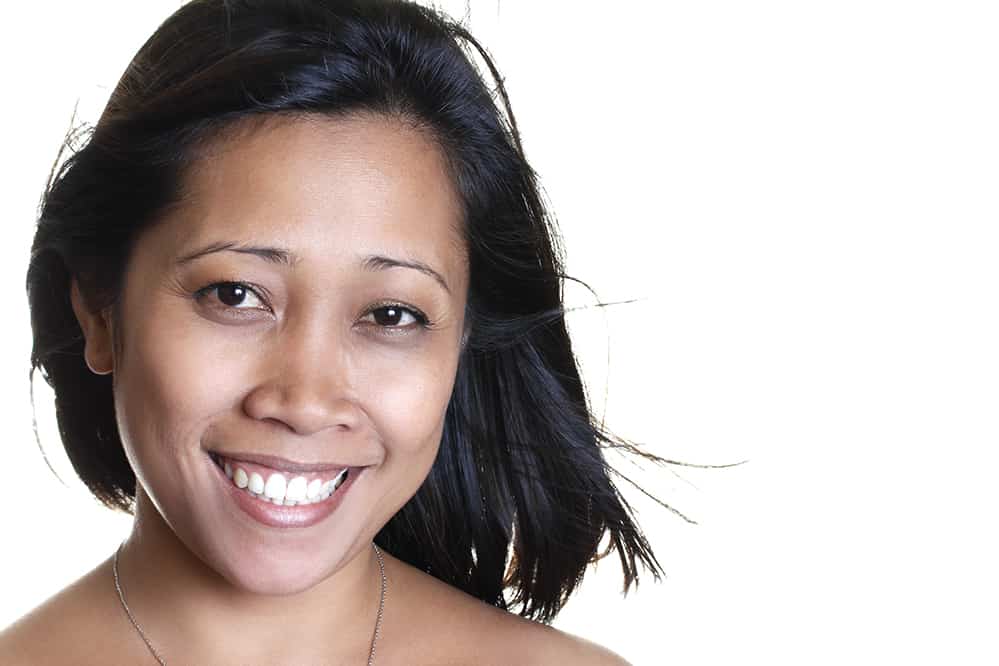
 Ruth Indiathi, founder of the “Balinese Village” Balinese
Hello, Ruth. The How To Spa team is delighted to interview you, the Balinese massage specialist. Thank you for having us.
Can you tell us more about your background and your current work?
As an Indonesian spa therapist, I received my initial training in Indonesia in the 1990s on the islands of Java and Bali, primarily at what could be considered the precursors to today’s spas. There, we practiced Balinese body and scalp “creambath” massages, facial massages, as well as traditional treatments such as Mandi Lulur, Mandi Susu, Mandi Rempah, and Boreh. It goes without saying that my very first introductions to these practices date back to my childhood. These roots are obviously incredibly important, as it is a world of trust, tranquility, and curiosity that parents pass on when massaging a child. This inspires me and permeates my teaching.
I worked for Cinq Mondes in Paris in the early 2000s, during the spa boom in France, and then became a spa consultant for the Institut Coiffure et Nature in Bastille, the Six Senses Spa, the Shangri-La, and the Park Hyatt Paris. In 2007, I began working as an instructor for various schools. In 2011, I founded the professional training organization Village Balinais Formation in Paris. This center is dedicated to teaching Balinese massage to professionals (spa therapists, estheticians) in Paris and through immersion programs in Bali. In 2016, I also opened a private Balinese massage studio in the heart of Paris, where I welcome and treat private clients.
I consider Balinese massages to be a form of yoga, a natural, daily form of body therapy. They facilitate a journey toward the fulfillment of the body and the self. They allow us to go far beyond the distorted image and experience that clients usually have when they are familiar with overly simplified versions or have had a sometimes painful and chaotic experience in Bali.
The best Balinese massages are the Pijitan®/pijat Bali because they are the most comprehensive and technically structured, the most faithful to the Hindu-Buddhist tradition and the Indonesian archipelago where they originated, and at the same time, they are designed for people here. They lead to a deep sense of well-being, a natural sense of fulfillment, quite simply.
Among all the physical and emotional benefits they provide, they are characterized by the immense pleasure they bring, which is linked to the mental and physical relaxation they induce.
Your school offers training in the famous Balinese massage. This traditional Indonesian massage provides specific benefits. What are they?
I offer treatments based on the Balinese massage technique known as pijat Bali.
Both preventive, deeply sensory, and physical, I honor—through both practicing and teaching these techniques—the spirit of Indonesian expertise, which involves massaging the body’s surface to clear the mind and reconnect with oneself, the present moment, and what truly matters but is not usually visible: the body’s physical and relational needs, and the tensions that manifest within it.
On the physical level
1) They restore muscle tone, increase muscle flexibility, and treat tight areas (tension, muscle soreness, and stiffness in the neck and back).
2) They enhance sensory awareness and proprioception (perception of internal sensations).
3) They affect the circulatory system by flushing out toxins, thereby cleansing and purifying the body.
From a mind-body perspective
1) They are a remarkable source of self-fulfillment and lightheartedness.
2) They relieve fatigue and contribute to better sleep: As you enjoy the relaxation they provide, the pressures and thoughts that weigh on and tire the mind fade away, and internal agitation subsides.
3) In this moment of letting go brought about by the techniques of Balinese pijat, a gap in time and in the body begins to open up, , the client gains access to sensations and emotions that are usually unnoticed.
4) As a final benefit, the ultra-sensory techniques applied to the body’s surface in Balinese pijat and the spa therapist’s positioning—inspired by the Hindu-Buddhist tradition—lead to a new form of communication based on trust and empathy.
Are there different versions of this massage? Can it be received by everyone?
Balinese massages are diverse in that they are hybrid, drawing on Indian and Chinese medicine as well as the local traditions of the thousands of islands that make up the archipelago—the largest in the world. There is no single, standardized form of Balinese massage; rather, there are various styles.
Anyone can receive them, provided they follow the usual precautions and any medical restrictions that may apply.
Women and men who appreciate living life to the fullest and with respect will value the aesthetic expression of their femininity and masculinity.
By helping to restore muscle tone and relieve sore muscles, it is ideal for recovery for athletes and dancers.
Soothing and rejuvenating, they help restore a good night’s sleep. Engineers, journalists, and restaurant owners will appreciate it. Combined with a Balinese head massage (pijat kepala), the pijitan®/pijat Bali works wonders.
Whether you’re shy, emotional, or lacking in affection, you’ll appreciate its sensory qualities and the reawakening of simple sensations within a peaceful relationship.
You also offer other types of Indonesian massages. Can you tell us more about them?
There are many types of massage. In Indonesia, Balinese body massage is called pijat or urut; in France, I renamed them pijat Bali (body, abdominal, prenatal, Siamese pads, volcanic stones). There is another remarkable massage: the scalp massage. Known as “Creambath” in Indonesia, I renamed it “pijat kepala” in France and later “pliritan®,” a term that everyone in France has adopted. A hair beauty treatment in Indonesia, it is distinguished in France by the intense mind-body relaxation it provides and its combination with Balinese body or facial massage. Indonesia also offers its own versions of palm and foot reflexology, which can be found at my school.
Finally, according to you, What are the best places to get some exceptional Balinese massages (in France and/or around the world)?
In Indonesia, there’s plenty to eat and drink! So, I recommend that you try as many things as possible!
In Paris! As you know, I work at a studio called the “Private Balinese Massage Studio.” It’s located in the heart of Paris, in the lively Canal Saint-Martin neighborhood, just 2 minutes from Place de la République.
Conducted according to best practices and in accordance with protocol—while, of course, tailoring the approach to individual needs—my clients particularly appreciate the minimalist and private setting, the personalized care from one session to the next, the mind-body connection that develops through the body, the profound sense of fulfillment they experience, the insights this can bring, and above all, the pleasure of deep relaxation. They also appreciate having quiet time without any distractions after the sessions. I think they appreciate my rates, too!
I highly recommend the graduates who have trained at my school. The list is long—they work in spas, luxury salons, and luxury hotels, or are self-employed as fitness coaches, personal trainers, naturopaths, or bed-and-breakfast owners…. I wouldn’t want to offend anyone I might accidentally leave out. Some people use these techniques for their benefits without mentioning their origins. Estheticians appreciate them and use them for their deeply relaxing properties and their ability to be combined with body treatments. Their balanced nature is also an asset, since they allow for much more to be achieved than many traditional Asian body massages, which can quickly become exhausting for the esthetician. These come to mind.
In Paris, Ruth Indiathi, a private Balinese massage studio, http://www.levillagebalinais.com/blog/, tel. 06 50 20 62 33
Near Lille, Rebecca: Massages in Lille: http://www.lille-aux-massages.fr/
Near Strasbourg, Caroline, esthetician: Bayi Institut: bayi.institut@hotmail.fr
In Reims, Jessica, esthetician: Prélude Beauté: www.institut-preludebeaute.fr/
In Epernay, Marlies offers Balinese massage. She’s on Facebook.
In Bordeaux, Fabrice: http://www.fabrice-escher.fr/
Near Nîmes—in Uzès, to be exact—Fabienne runs “La Maison Rouge,” a beautiful bed-and-breakfast. She offers Balinese massages upon request: www.maison-rouge-uzes.com
Author: Ruth Indiath
You’re interested in:
1- Professional training in traditional Balinese massage: This program takes place year-round in Paris at our professional training center, the Village Balinais. Training and immersion in Indonesia (Bali) are offered during the summer.
2- Enjoy a Balinese pijat Bali massage at the private Balinese massage studio: Take a step back, focus on yourself and your well-being in a haven of peace and tranquility.
Village Balinais: Balinese Massage Training and Private Studio, Paris
9 Rue de la Fontaine au Roi, 75011 Paris
To register or make an appointment:
Contact: Ruth Indiathi
Phone: 06 50 20 62 33
Email: levillagebalinais@gmail.com
Blog: http://www.levillagebalinais.com/blog/
Text written by Ruth Indiathi